Square Bitcoin in 2026: 800,000 Sellers Are Auto-Enabled. What Comes Next?
Square Bitcoin payments are now auto-enabled for 800,000 sellers. Our research shows what acceptance attracts and what to layer on top.

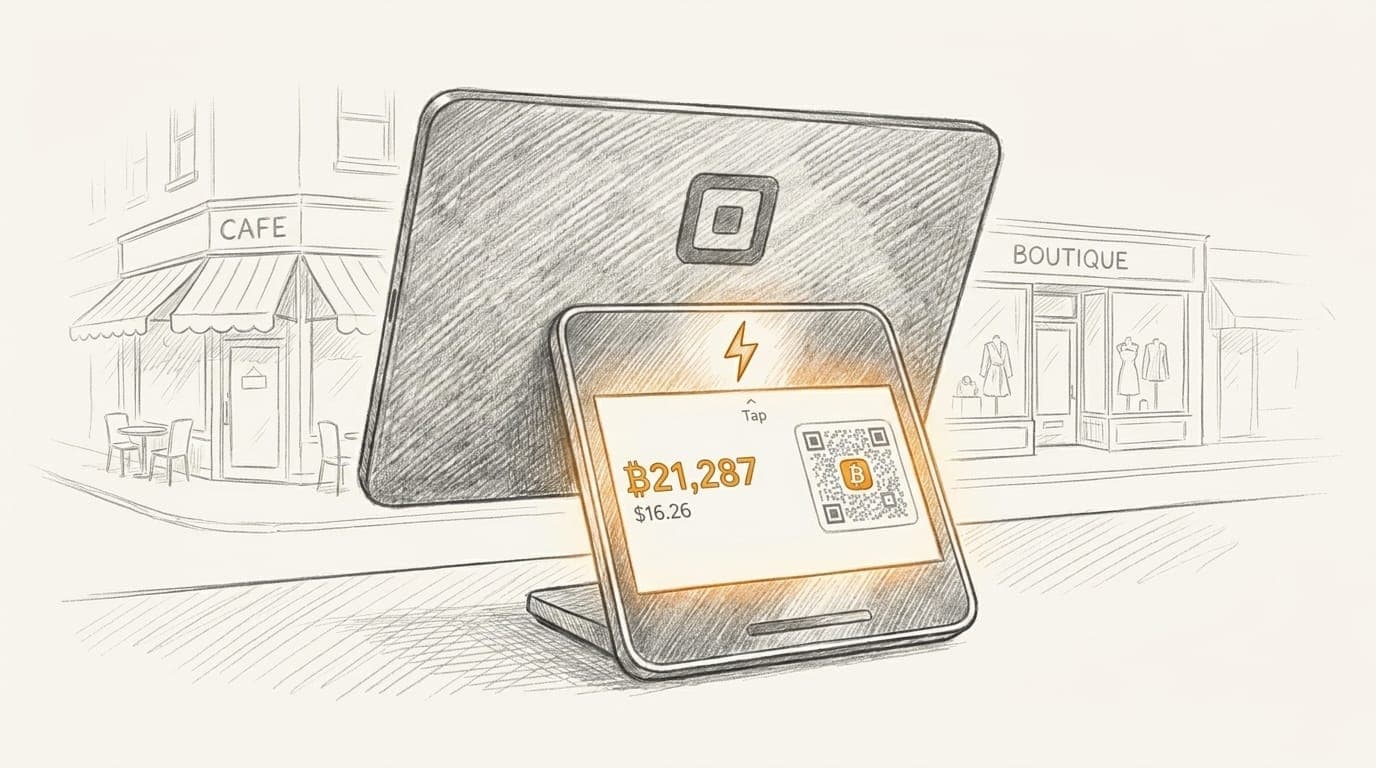
At The Bitcoin Conference in Las Vegas this week, Miles Suter, Bitcoin Product Lead at Cash App and Square, shared a number that should change how every small business thinks about Bitcoin payments.
800,000 Square merchants are now Bitcoin-enabled. A new one onboarded every 8 seconds.
That number ends one debate and starts another. The debate it ends is whether accepting Bitcoin is technically feasible for a small business. The infrastructure is there. The integrations work. The customers exist.
The debate it starts is what the actual leverage in this is for an SMB. Is Bitcoin payment a checkbox feature, or is there something underneath it worth building around?
We've spent two years measuring exactly that question across the merchants on our network. The data has held up under external statistical review and across two separate studies. Here's what it shows.
Acceptance is the entry point, not the leverage
For most of the last decade, "should I accept Bitcoin?" was a question about plumbing. You needed to pick a payment processor, integrate it with your checkout, train staff, and handle the variable accounting. Most small businesses said no, not because they were anti-Bitcoin, but because the operational lift wasn't worth a payment method less than 1% of customers used.
Square's number changes the calculus, and the way they got there matters. Most of the 800,000 merchants didn't actively evaluate Bitcoin and decide to turn it on. Square flipped the default. Automatic Bitcoin payments (settled in dollars) are now enabled for new U.S. sellers at eligible locations, with existing eligible sellers reached as the rollout proceeds. Merchants are free to opt out from settings if they don't want it. (Sellers in New York are excluded.) The friction that kept Bitcoin out of mainstream commerce for a decade hasn't just dropped to zero. It's been inverted. The default position for an eligible Square merchant is now "Bitcoin-enabled."
Square has stacked the deal beyond just acceptance. Bitcoin payments settle in dollars by default (merchants can choose to settle in Bitcoin instead), processing fees are 0% through December 31, 2026 and 1% after, and Square doesn't support chargebacks or dispute handling on Bitcoin transactions. For an SMB owner, that's a meaningful operational and economic simplification before any customer-side analysis even enters the picture.
That's good news with a footnote. The 800,000 number includes a large share of merchants who got there by not opting out, not by strategically choosing to engage with Bitcoin payment. They're technically accepting Bitcoin. Most of them probably haven't thought about who's paying with it, what those customers do, or what to layer on top.
That's the opportunity for a merchant who does strategically engage. The customer-side question, who actually shows up when you turn this on and what they do once they're there, has been answered separately from the integration question. Most merchants who get auto-enrolled in Bitcoin acceptance never see the answer because they're looking at it as a payment method, not a customer-acquisition channel.
The Cash App Bitcoin Back program shows what's possible at the wallet layer
Block didn't stop at acceptance. Alongside the 800,000-merchant milestone, Cash App rolled out a promotional incentive called Bitcoin Back, active through December 31, 2026. Cash App customers earn 5% back in Bitcoin on every qualifying purchase when they pay with Bitcoin (directly or via Cash Balance over Lightning) at Square sellers, capped at $30 per month per customer, automatically deposited to their Cash App Bitcoin balance. Customers find participating sellers through a Bitcoin Map inside the Cash App. It's a clean, well-built program from a company with the distribution and the wallet to make it work at scale, and the fact that Block is investing this aggressively in Bitcoin payments is a structural win for the entire ecosystem.
It's also, by design, narrow in who it touches and bounded in size.
The customer has to be a Cash App user. They have to choose to pay with Bitcoin at the register, via Cash App, at a Square seller. The 5% reward caps at $30 per month per customer, which means even a heavy user running their grocery budget through Cash App tops out at the equivalent of $600 in qualifying monthly purchases. The program is also time-bound, ending December 31, 2026, unless Cash App extends it.
By any reasonable estimate, this concentrates value on a small slice of any merchant's total foot traffic and is structurally bounded in per-customer contribution. The 95%+ of a typical merchant's customer base who don't use Cash App, or don't pay in Bitcoin at the register, sees nothing different at checkout.
There's also a discoverability layer most merchants overlook. Being auto-enabled for Bitcoin payment doesn't automatically put a Square seller on the Bitcoin Map inside Cash App, the in-app surface customers use to find Bitcoin Back-eligible places. Joining the Bitcoin Map is a separate opt-in (Add me to the map in Square's Bitcoin payment settings). A merchant who's accepting Bitcoin by default but hasn't opted into the Map isn't visible to Cash App customers searching for places to spend, and isn't capturing that share of the Bitcoin Back tailwind.
This is not a criticism of the program. The Cash App incentive does exactly what it was built to do, which is bring Cash App users into Bitcoin payment as a habit, and every Bitcoin merchant benefits from the awareness lift Block is creating.
The point is that "Bitcoin payment incentive at the wallet layer" and "Bitcoin rewards program at the merchant layer" do different things. The wallet incentive concentrates capped value on the small segment of customers already using a specific wallet to pay in Bitcoin, for a defined window. The merchant rewards layer extends uncapped value to every customer the business has, regardless of how they paid, on the merchant's own timeline, and builds direct loyalty back to the merchant rather than to the wallet.
For a merchant who wants both effects, the layers stack. The Bitcoin Back program captures the Bitcoin-native shopper who walks in already paying in Bitcoin via Cash App. A merchant Bitcoin rewards program captures everyone else, introduces the rest of the customer base to Bitcoin gently (earn, claim, redeem, eventually maybe withdraw to Cash App or another Lightning wallet), and continues running after December 31 when the wallet incentive ends.
That's the level-up move. Not a replacement for what Block built. A complement to it.
What 50,000+ shoppers told us about Bitcoin customers
Across the merchants on the Oshi network, we identified every customer who paid via a Bitcoin payment gateway over a two-year window. We compared them to every other customer at the same stores, controlling for store mix and price points. The findings replicated across all qualifying merchants.
Bitcoin customers spend 38% more on their first purchase. The premium is there from day one, before any reward, before any repeat-purchase dynamic. They show up and spend more.
They return for a repeat purchase at 53% versus 28% for everyone else. Nearly twice the repeat rate. There are no auto-ship subscriptions backing this up. Bitcoin payment requires a customer to deliberately open a wallet and choose to pay. Every repeat visit is a conscious decision.
They generate nearly 3x the lifetime value. This is the compounding result of the first two findings. Higher AOV times higher repeat rate equals a customer profile that doesn't exist in most loyalty programs.
They opt into marketing at 84% versus 66% for everyone else. Despite being more privacy-conscious on average, Bitcoin customers want to hear from brands they choose. The list-building advantage compounds over time.
Even when Bitcoin's price falls, they still spend 39% more than typical customers at the same store. We classified every month in the study by Bitcoin's price action. The premium contracts in down months but it never closes. The floor in down months is still higher than the ceiling for everyone else.
You can read the full study with the per-merchant breakdowns and methodology.
The simple read on this data: customers who pay with Bitcoin self-select into being a higher-value segment. Acceptance is what unlocks that segment. The 800,000 Square merchants who flipped Bitcoin payments on now have access to a customer profile that other merchants don't.
The second effect that most analyses miss
Here's the part that surprised us most.
The customer-profile effect explains what happens when someone pays with Bitcoin. It does not explain what happens when someone earns Bitcoin as a loyalty reward but pays with a normal card.
So we ran that study separately.
40,000 customers across 7 merchants. Each customer compared to themselves before and after enrollment in a Bitcoin rewards program. Matched control group. Calendar-time matching. Pre-spend matching. Pre-trend checks. Methodology was reviewed by an external statistician before publication.
The result: enrollment in a Bitcoin rewards program is associated with measurable spending lift across the entire enrolled customer base, regardless of whether the customer ever pays with Bitcoin. The lift survived every correction we applied and replicated independently across all 7 merchants.
The full methodology piece walks through every correction. The headline takeaway is simple. There are two distinct effects, and they compound.
- Acceptance effect. Bitcoin payment acceptance attracts a higher-value customer profile. This is selection.
- Rewards effect. Bitcoin rewards programs lift spending behavior across the enrolled customer base. This is behavior change.
Acceptance attracts the segment. Rewards move the needle for everyone you already have. Most merchants who turn on Bitcoin payment without layering rewards capture only the first effect. The leverage is in capturing both.
A three-stage framework for SMBs in 2026
Working backwards from the data, here's how I'd think about Bitcoin in a small business in 2026.
Stage 1: Accept. If you're on Square, Shopify, WooCommerce, BTCPay, or another commerce platform with Bitcoin payment support, make sure Bitcoin acceptance is on. On Square, it's now the default and you're already accepting it unless you've opted out. On other platforms it's typically a setting or a payment-app install. Either way, the friction is gone. You're filtering for a higher-value customer segment without doing anything else. This is the floor.
Stage 2: Reward. Add a Bitcoin rewards program on top of acceptance. Customers earn sats on every purchase, regardless of how they pay. This does two things at once. The rewards effect kicks in for your fiat-paying customers, which is most of your base. And your non-Bitcoin customers get gently introduced to Bitcoin from the merchant side, earning it, claiming it, eventually some of them withdrawing it to Cash App or another Lightning wallet. You're widening the Bitcoin funnel from the merchant end while Block widens it from the wallet end.
Stage 3: Compound. Connect into a network. The retention loop strengthens when customers can earn at multiple merchants, redeem locally, withdraw to a Lightning wallet if they want, and discover other Bitcoin-rewarding businesses through a marketplace. The acquisition loop strengthens through affiliates and referrals. This is where individual merchant economics start benefiting from network density.
The three stages are sequential but not separate. A merchant doing all three captures the customer-profile effect, the behavioral lift effect, and the network effect simultaneously.
What rewarding in Bitcoin actually looks like operationally
For the customer, a Bitcoin rewards program looks like any loyalty program. They make a purchase. They get an email saying they've earned rewards. They click to claim. The rewards happen to be denominated in Bitcoin instead of points.
The differences come later, and they're structural.
Rewards have real, external value. Customers can redeem locally for an amplified-value coupon at the originating merchant, or they can withdraw to a Lightning wallet after a hold period (typically 30 to 90 days). The asset belongs to them either way.
Multiplier mechanics create retention gravity. Sats earned at a specific merchant unlock amplified redemption value at that same merchant. A 1% reward rate paired with a 10% effective in-store discount produces a 10x multiplier when sats are redeemed in-store. This biases customers toward returning to the originating merchant rather than withdrawing.
Funding is configurable. Merchants can fund rewards directly, Oshi can fund the base purchase reward (with the merchant paying a SaaS fee instead), or any hybrid combination. This matters for cash flow during early adoption.
The Square integration handles all of this on top of the same Square dashboard a merchant already uses. The Shopify integration does the same on Shopify. There's no separate POS, no parallel checkout flow, no customer-facing crypto education required.
For a deeper comparison of how this differs from traditional points programs, see our piece on Bitcoin rewards versus traditional loyalty programs. For Square-specific setup, see Bitcoin rewards for Square POS.
Why nobody else publishes this kind of data
A reasonable question after reading this far: if Bitcoin customers are this much more valuable and Bitcoin rewards lift behavior this much, why hasn't the rest of the loyalty industry been measuring and publishing this?
I have my suspicions.
Most loyalty platforms publish vanity stats. "Members spend 3x more than non-members" is a common one. The problem with that comparison is that engaged customers self-select into loyalty programs. The 3x gap is mostly selection, not program effect. It's a misleading number, and the platforms publishing it generally know it.
The harder version of the analysis, the one that controls for selection effects with matched samples and pre-trend checks, generally produces smaller and less marketable numbers. Most platforms don't publish it because the results would weaken their pitch and they're not under competitive pressure to do better. The whole industry rounds up.
We published both studies because we wanted to know whether the effects were real or whether we were fooling ourselves. The findings held up. Whether other platforms eventually follow is up to them.
Bottom line
Square hitting 800,000 Bitcoin-accepting merchants is the structural shift. Block did the heavy lifting at the payment and wallet layer, and the Cash App incentive on top of that is going to deliver real volume to merchants who turn it on. That's a meaningful tailwind, and it's worth saying clearly: the work Block has done here is the kind of thing the Bitcoin community has been waiting on for years.
The next question for an SMB is whether to stop at acceptance or to add the merchant-side rewards layer that captures the rest of the base. The Cash App incentive concentrates on the small slice of customers paying in Bitcoin via a specific wallet. A merchant Bitcoin rewards program reaches everyone else, the 95%+ who are still paying with a normal credit card. The two don't compete. They stack.
If you accept Bitcoin and reward in Bitcoin, the data we've collected says you'll see two compounding effects: a higher-value customer segment showing up, and a measurable spending lift across the customers you already have. Both effects are independent. Neither requires your customers to know what Bitcoin is.
The merchants who notice this early build a moat with that customer base. The ones who treat Bitcoin payment as a checkbox payment method get the wallet-layer tailwind but not the merchant-layer loyalty.
To turn on rewards on top of an existing Square, Shopify, WooCommerce, or BTCPay setup, see how purchase rewards work. To see what the network looks like from the customer side, browse the merchant marketplace. To read the customer research yourself, the bitcoin-customers study and the loyalty-program-effectiveness study are both public.