Loyalty Program for Small Business: The Complete Guide (2026)
Enrollment doesn't mean engagement. This guide breaks down the types of loyalty programs that work for small businesses, why most programs fail, what they really cost, and a newer model that's quietly outperforming traditional points.

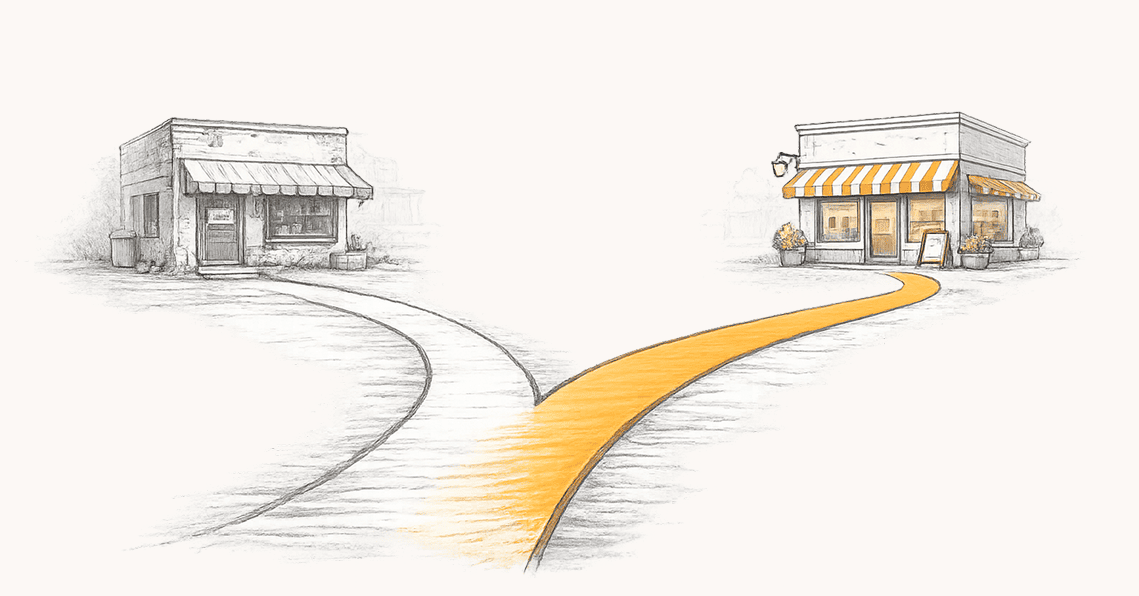
You can't outspend big retailers on customer acquisition. You don't have their ad budgets, their brand recognition, or their shelf space. But you do have something they struggle to build: real relationships with real customers.
A loyalty program is how you formalize that advantage. It turns a one-time buyer into a repeat customer and a repeat customer into someone who tells their friends. Done right, it's the most cost-effective growth channel a small business has.
Done wrong, it's a monthly fee that nobody notices.
This guide covers the types of loyalty programs available to small businesses, why most of them underperform, what they actually cost, how to launch one that works, and a newer approach that's quietly changing the math for merchants who want to stand out.
Why the Type of Program Matters
Loyalty programs work. But not all of them work equally well, and not all of them are worth the investment.
Deloitte's 2025 survey found the average consumer enrolls in eight loyalty programs but actively participates in only five. 40% admit they sometimes forget to redeem rewards entirely. BCG reported in 2024 that loyalty program engagement in the U.S. was down 10% from 2022, with more consumers considering switching programs.
The problem isn't that customers don't want loyalty programs. It's that most programs don't give them a reason to pay attention. Every program looks the same: earn points, redeem points, maybe unlock a tier. When your loyalty program is indistinguishable from your competitor's, it becomes background noise.
The merchants who get the most out of loyalty are the ones who choose a model that fits their business and offers something their customers actually notice. Here's how the options compare.
Types of Loyalty Programs for Small Businesses
Not every model works for every business. Here's an honest look at each type, what it's good for, and where it falls short.
Punch Cards and Visit-Based Programs
The original loyalty program. Buy nine coffees, get the tenth free.
What works:
- Simple, zero setup cost, no technology required
- Customers understand it immediately
- Great for high-frequency, low-ticket businesses like coffee shops, bakeries, and quick-service restaurants
What doesn't:
- Zero customer data. No emails, no purchase history, no way to follow up
- Cards get lost, forgotten in pockets, or crumpled under car seats
- No way to run promotions, segment customers, or measure whether the program is working
- Nothing stopping a competitor from offering the exact same card
Points-Based Programs
The most common digital loyalty model. Customers earn points on purchases and redeem them for discounts, free products, or store credit.
What works:
- Flexible, easy to set up through platforms like Smile.io, Yotpo, or LoyaltyLion
- Gives you customer data and purchase history
- Can layer on email campaigns and promotions
What doesn't:
- Customer apathy is the biggest challenge. Points are abstract and forgettable
- People don't plan purchases around earning points at a small business. They discover their balance at checkout when they're already committed to buying. The reward didn't drive the visit; it just discounted a sale that was happening anyway
- Every competitor can run the exact same program with the same platforms. No differentiation, no conversation, nothing worth sharing
VIP and Tiered Programs
Customers unlock higher reward rates or exclusive perks as they spend more. Bronze, Silver, Gold, or however you want to structure it.
What works:
- Creates aspirational behavior. Customers see their progress toward the next tier, which encourages incremental spending
- Higher tiers can include perks beyond discounts: early access to new products, exclusive items, priority support, or community access
- Research from Antavo shows consumers, especially younger ones, value experiential perks and status recognition, sometimes more than the discounts themselves
What doesn't:
- Requires enough repeat purchase volume to make tiers meaningful. If your average customer buys twice a year, they'll never progress
- Works best for natural repeat cycles: food, consumables, skincare, coffee, supplements
- Less effective for one-time or infrequent purchases
Store Credit and Discount-Based Programs
Instead of abstract points, customers earn a straightforward dollar amount or percentage back as store credit.
What works:
- Simple value proposition customers understand immediately
- No conversion math, no confusion about what points are worth
- "You earned $5 in store credit" is clearer than "You earned 500 points"
What doesn't:
- True cashback (actual dollars to a customer's bank account) is functionally impossible for most small businesses. It requires banking information, ACH integration, and the ability to send very small amounts over traditional rails. Banks can do it because they are the bank. A small business selling skincare or beef jerky doesn't have that infrastructure
- Store credit works, but it's still a discount on the next purchase. No excitement, no word of mouth, no differentiation
Referral Programs
Existing customers share a link or code with friends. When someone makes a purchase through that link, both the referrer and the new customer get a reward, usually a discount or store credit.
What works:
- Turns your best customers into an acquisition channel
- People trust recommendations from friends more than ads
- Can drive new customers at a fraction of the cost of paid advertising
What doesn't:
- The incentive is usually a discount at your store, meaning your biggest advocates get rewarded with... a coupon. They were already going to buy from you
- The mechanism is useful, but the reward itself isn't exciting or shareable. "I got 15% off my next order" doesn't exactly go viral
- Works best when layered on top of a loyalty program that already gives customers something worth talking about
Bitcoin Rewards
A newer category. Instead of proprietary points or store credit, customers earn real Bitcoin (called sats) on their purchases. The merchant funds rewards in dollars. No crypto knowledge is needed on either side.
What works: The reward has real, transparent market value that isn't set or controlled by the business. It can't be devalued the way points can. Customers who don't know or care about Bitcoin use the program exactly like a traditional rewards program: they earn, they redeem for store credit, they come back. It works the same way.
But it also gives you access to one of the most valuable customer segments in commerce. Research across 50,000+ shoppers shows that Bitcoin customers spend 38% more on their first purchase, generate nearly 3x the lifetime value, and are 50% more likely to make a repeat purchase. A Bitcoin rewards program is how you attract them.
Unlike every other loyalty model, Bitcoin rewards turn your program into an acquisition channel, not just a retention tool. Your store becomes visible to a growing base of Bitcoin consumers through reward networks, influencers, and community discovery. Think of it as the difference between building a proprietary intranet versus joining the internet. Points are locked to your store. Bitcoin rewards connect you to a broader network of high-value customers who are actively looking for businesses that speak their language.
And because the reward is real, portable value, not proprietary tokens, customers actually talk about it. That word-of-mouth is something traditional points programs almost never generate.
Why Most Loyalty Programs Fail
Before you pick a platform, it's worth understanding why so many programs underperform. The failure rate is high, and the reasons are predictable.
The reward isn't worth noticing. A 1% points rate on a $30 purchase is 30 cents of value locked inside a proprietary system. The customer doesn't feel it, doesn't think about it, and doesn't change their behavior because of it. If your reward doesn't register as real value, the program is invisible.
The program looks like everyone else's. When four businesses on the same street all offer "earn points, redeem for discounts," none of them stand out. The Deloitte data confirms this: consumers enroll in eight programs and actively use five. The three they ignore are the ones that feel interchangeable. If your program doesn't give customers a reason to choose yours over the others, it won't.
Enrollment gets confused with engagement. Many platforms celebrate sign-up numbers. But a customer who enrolled six months ago and hasn't returned isn't a loyalty success. BCG's data showing a 10% decline in engagement tells the real story: people signed up and then stopped caring. The metric that matters is repeat purchase rate, not enrollment count.
The program only retains, it doesn't acquire. Most loyalty programs are purely defensive. They reward customers who were already going to buy from you. They don't bring in new customers. This is fine if your only goal is retention, but most small businesses need both. If your program doesn't generate word of mouth or make your store discoverable to new audiences, it's only solving half the problem.
There's no proof it works. This is the uncomfortable truth about the loyalty industry. The largest points-based platforms — Smile.io, Yotpo, LoyaltyLion — publish customer testimonials and feature lists, but none have released controlled, methodologically rigorous research showing what their programs actually deliver in measurable ROI. If a platform can't show you evidence that their approach works, ask yourself why.
How to Choose the Right Program for Your Business
The best loyalty program is the one your customers actually use. Here are the questions that matter:
What's your repeat purchase cycle? If customers buy weekly (coffee, food, consumables), even a simple punch card can work. If they buy quarterly or less, you need something with more pull, like tiered rewards or a reward type that's inherently interesting.
What's your average order value? A 1% reward rate on a $10 purchase is 10 cents — the customer doesn't feel it. On a $100 purchase, that's a dollar of real value. Your reward rate needs to produce a reward that the customer actually notices.
What makes your brand different? If your products are high quality and you take pride in what you make, your loyalty program should reflect that. A generic points program doesn't say "we're different." A Bitcoin rewards program, or a program with genuine VIP perks, signals that you think about things differently.
Do you want to retain existing customers, acquire new ones, or both? Most loyalty programs are purely defensive. They keep the customers you already have. If you want acquisition too, you need a referral mechanism, a network that drives discovery, or a reward type that generates word of mouth. Very few programs do both. Bitcoin rewards is one of the few that does.
Does your platform integrate with your existing tools? Check for native integrations with your e-commerce platform (Shopify, WooCommerce, Square), your email marketing provider, and any other tools in your stack. A loyalty program that doesn't connect to your checkout is dead on arrival.
Side-by-Side Comparison
| Punch Card | Points | VIP Tiers | Store Credit | Bitcoin Rewards | |
|---|---|---|---|---|---|
| Setup complexity | Very low | Low | Medium | Low | Low |
| Customer data | None | Yes | Yes | Limited | Yes |
| Differentiation | None | Low | Medium | Low | High |
| Devaluation risk | N/A | Possible | Low | None | None (market-priced) |
| Acquisition potential | None | Low | Low | None | High (network effects) |
| Word of mouth | None | Low | Low | None | High |
| Works without customer buy-in | Yes | Yes | Yes | Yes | Yes |
| Published ROI research | No | No | No | No | Yes (see study) |
| Best for | High-frequency, low-ticket | General retail | Brands with loyal base | Simple e-commerce | Brands wanting to stand out |
What Does a Loyalty Program Actually Cost?
Traditional points platforms charge a monthly subscription that scales with your order volume. Entry-level plans start around $49/month with limited features. Mid-tier plans that include referrals, VIP tiers, and custom branding typically run $199-$599/month. Enterprise plans at platforms like Yotpo can exceed $1,000/month. On top of the subscription, some platforms charge per-transaction fees or limit the number of orders your plan covers.
Square Loyalty is simpler: $45/month per location. It integrates natively with Square POS but is limited to Square's ecosystem.
Punch cards are essentially free — just the cost of printing cards. But you get no data, no digital engagement, and no way to measure results.
Pay-as-you-go models also exist, where there's no monthly platform fee. Instead, you fund a rewards balance and only spend money when customers make purchases. Your cost is directly tied to customer activity rather than a flat subscription.
The real question isn't what a loyalty program costs — it's what it returns. A $199/month platform fee is a bargain if the program generates $2,000 in incremental revenue. It's a waste if it doesn't. When evaluating platforms, ask for ROI data — not testimonials, but controlled research with methodology you can evaluate. If a platform can't show you what their program actually delivers, that should factor into your decision.
What to Look for in a Loyalty Platform
If you're evaluating platforms, here's what to check:
- Integration. Does it connect natively to your e-commerce platform? Manual setup or custom code means more maintenance than benefit.
- Real costs. Understand the full picture: monthly fee, per-transaction fees, and what features are locked behind higher tiers. Some platforms charge more just to unlock basics like email branding or referral programs.
- Customer experience. Can customers use it without friction? App downloads, account creation, and confusing redemption flows kill participation. The best programs integrate into the checkout they already know.
- Beyond points. Does it offer referral programs, VIP tiers, campaigns, and analytics? Points-only platforms leave money on the table.
- Email and branding. Can you send branded notifications from your own domain? Platform-branded emails erode trust and look generic.
- Scalability. Will it work if your business doubles? Will pricing still make sense? Does it support additional locations, channels, or product lines?
- Published results. Ask the platform: "Do you have controlled research showing what your program delivers in ROI?" If the answer is testimonials instead of data, factor that into your decision.
How to Launch a Loyalty Program
1. Know Your Repeat Purchase Cycle
Before you pick a platform, look at your existing data. How often does a typical customer come back? If it's weekly, almost any program will work. If it's monthly or quarterly, you need a reward that's compelling enough to accelerate that cycle. If most customers only buy once, your real problem is acquisition, not loyalty — and you need a program that does both.
2. Set Your Reward Rate Based on Your Margins
A reward rate of 1% of purchase value is standard for purchase rewards. You don't need to go higher to see meaningful results.
Here's the math: if your reward rate is 1% and your average order is $75, each purchase costs you $0.75 in rewards. If that reward drives even one additional visit, the program pays for itself many times over. The numbers work at almost any reasonable margin.
3. Choose a Platform That Integrates With Your Stack
If the platform doesn't integrate natively with your e-commerce system — Shopify, WooCommerce, Square, or whatever you're running — stop evaluating it. A loyalty program that requires manual processes or custom code won't survive the first month.
4. Launch Simple, Then Layer
Start with purchase rewards only. Don't try to configure VIP tiers, referral programs, campaigns, and social engagement all on day one. Get the core loop working: customer buys, customer earns a reward, customer receives a notification. Once that's running smoothly (give it 2-4 weeks), add a referral program. After you have 60-90 days of purchase data, set up VIP tiers with thresholds based on actual customer spending patterns, not guesses.
5. Measure What Matters
You can start looking at preliminary data around 90 days, but it takes roughly six months to get a meaningful picture of how your program is performing. The metrics that matter:
- Repeat purchase rate — Is it going up? Compare enrolled customers to non-enrolled customers over the same period.
- Revenue per customer — Are loyalty members spending more than they were before enrollment?
- Reward redemption rate — If nobody is redeeming, the rewards aren't compelling enough. If everyone is redeeming on every purchase, your rate might be too generous.
- New customer acquisition — Is the program (through referrals, network effects, or word of mouth) bringing in customers who wouldn't have found you otherwise?
If you can't answer these questions with your current platform, that's a problem with the platform, not with loyalty programs.
The Bitcoin Rewards Advantage
If you've read this far, you already understand the landscape. Here's why Bitcoin rewards deserve a closer look.
The mechanics are simple. You fund your rewards balance in dollars. No need to buy, hold, or understand Bitcoin. You set a reward percentage (1% is standard for purchase rewards). When a customer makes a purchase, their Bitcoin reward is calculated automatically. They receive a branded email from your business and claim their reward through a customer portal. They can redeem for store credit at your business, withdraw to a personal Bitcoin wallet, or hold their balance.
The data is compelling. Research across 50,000+ shoppers on the Oshi network shows that Bitcoin customers generate nearly 3x the lifetime value, spend 38% more on their first purchase, return 50% more often, and opt into marketing at 84% vs. 66% for everyone else. These numbers hold even when Bitcoin's price is falling. The premium shrinks, but it never disappears.
And those aren't vanity metrics. A separate study across 40,000+ customers at 7 merchants using matched control groups found that every $1 spent on Bitcoin rewards generated $10 or more in additional customer spending. The results held across categories: a food and drink merchant saw $22 in additional spending per $1 of rewards. A health and wellness merchant saw $21. A skincare brand saw $14. Every single merchant in the study showed statistically significant positive results. The full methodology — including how we controlled for selection bias, excluded enrollment purchases, and matched on pre-spend and calendar time — is published and was independently reviewed.
It's the first real "cashback" for small businesses. Traditional cashback requires banking infrastructure that small businesses don't have. Bitcoin changes that. You can send real, portable value to a customer instantly over the Lightning Network, even tiny amounts. For the first time, a small business can offer genuine cashback-like rewards without being a bank.
It works for customers who don't care about Bitcoin. This is the most common misconception. If a customer has zero interest in Bitcoin, the program functions exactly like any other loyalty program. They earn rewards, they redeem for discounts at your store. We've seen customers of all ages, including people in their 70s and 80s, redeem rewards for store credit without knowing or caring that Bitcoin was involved.
It works differently for customers who do care about Bitcoin. And that's where the advantage compounds. Bitcoin customers are a fast-growing, highly intentional consumer segment. They research brands, buy quality, and spend with purpose. They're also vocal advocates who share the businesses they support across social media and Bitcoin communities. Offering Bitcoin rewards is how you become visible to this segment and tap into a network that traditional loyalty programs can't reach.
Retention and acquisition in one program. Traditional loyalty is purely defensive: keep the customers you already have. Bitcoin rewards turn your program into an offensive weapon. (If you're currently using a traditional platform, see how Bitcoin rewards compare to Square Loyalty.) Your store becomes discoverable through the Oshi network, Bitcoin influencers promote participating merchants, and the reward type itself generates the kind of word of mouth that points never do.
The research exists and it's public. We've published two major studies — one on Bitcoin customer behavior (50,000+ shoppers) and one on loyalty program effectiveness (40,000+ customers, 7 merchants, matched controls). Both are available in full on our website. We believe this is the most rigorous loyalty program research any small-business-focused platform has published. If another platform has comparable data, we haven't found it.