Your Business Is the New Bitcoin Faucet
The original Bitcoin faucet cost a few thousand dollars and changed an industry. Today, individual merchants distribute many multiples of that in Bitcoin rewards, and they're seeing a return on every sat.

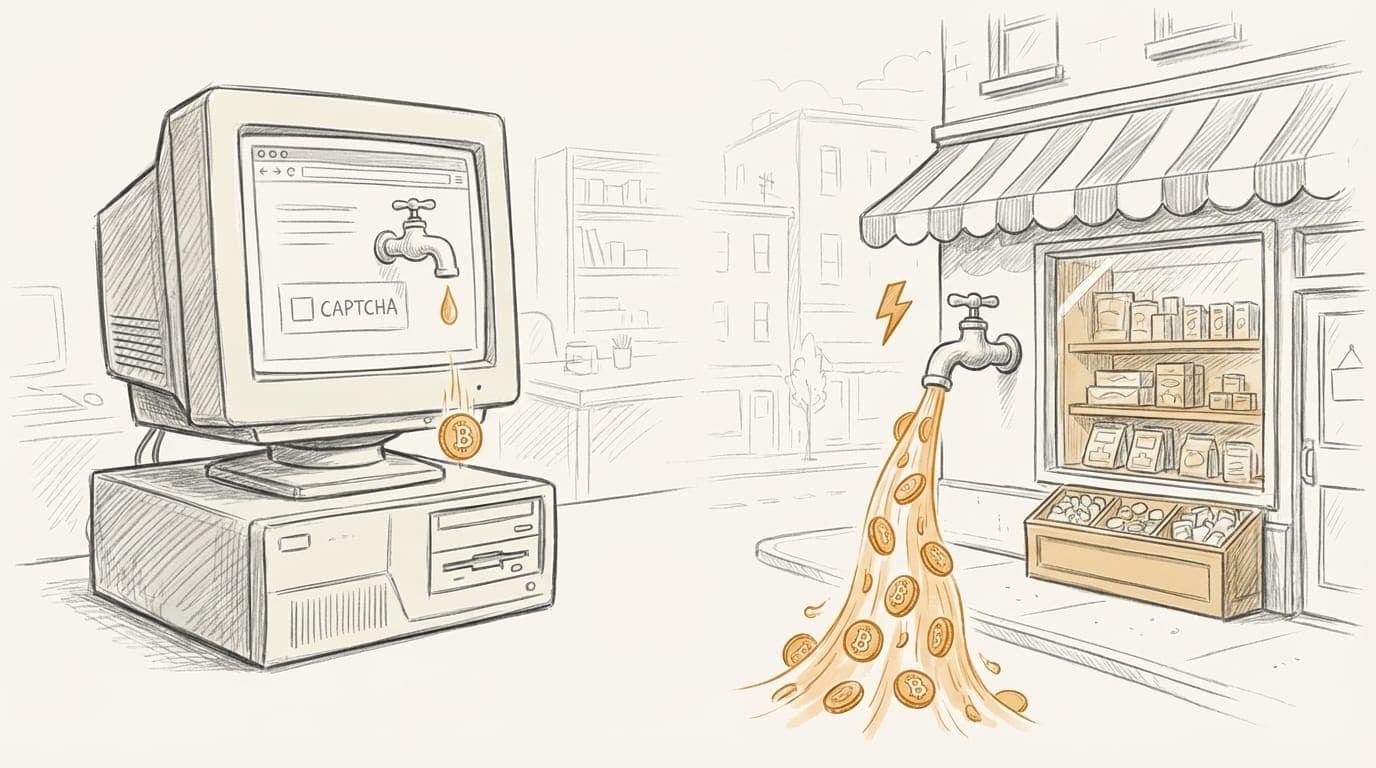
The Bitcoin faucet is back in the news. Block, the parent company of Cash App and Square, just put up $1 million in Bitcoin for a campaign they're calling a faucet revival, and it's great to see a company of that scale investing in putting Bitcoin into new hands. It's a meaningful signal that Bitcoin distribution is something worth doing.
It also raises an interesting question: if the original faucet kickstarted adoption among developers in 2010, what does the merchant version of that look like? Because it turns out small businesses have been quietly doing their own version of this for over a year, distributing far more value than the original faucet ever did, and seeing a measurable return on it.
What's in This Article
- The Original Bitcoin Faucet
- Merchants Have Already Surpassed It
- The Difference: This One Has a Business Model
- From Tinkerers to Mainstream Consumers
- What This Looks Like in Practice
- Frequently Asked Questions
The Original Bitcoin Faucet
In June 2010, Bitcoin developer Gavin Andresen launched a website that gave 5 BTC to anyone who solved a CAPTCHA. He called it the Bitcoin Faucet. Over two years, it distributed roughly 19,700 BTC to a few thousand people, mostly software engineers and cryptography enthusiasts.
At the time, Bitcoin was worth fractions of a penny. The total cost of the faucet, at the time of distribution, was estimated at a few thousand dollars. Andresen wanted more people to hold Bitcoin so they could experiment with it. It worked. Many of the developers who built Bitcoin's early infrastructure first encountered it through the faucet.
But the audience was narrow: technical people who were already interested in cryptography and peer-to-peer protocols. The faucet did nothing for mainstream awareness. Most of the coins were lost or spent long before Bitcoin became valuable. At today's prices, those 19,700 BTC are worth over $1.3 billion.
Merchants Have Already Surpassed It
The original faucet cost Andresen somewhere between a few hundred and a few thousand dollars at the time he ran it. That's the actual dollar amount that went out the door. Everything beyond that is appreciation that happened after the Bitcoin left his hands.
Individual merchants running Bitcoin rewards programs through Oshi have distributed, at the time of this writing, rewards worth 20 to 30 times the dollar value that the entire original faucet cost at the time it was operating. Not across the whole platform. Individual businesses.
A single small business selling products online has put more current-dollar value in Bitcoin into the hands of its customers than Andresen's entire two-year giveaway cost him. That's remarkable.
The nature of the value is different too.
Andresen's faucet was back-loaded value. It cost almost nothing at the time. The staggering dollar figures only materialized years later, after Bitcoin appreciated by millions of percent. Nobody planned for that outcome. Nobody could have. It's one of the great accidental wealth creation stories in technology.
Merchant Bitcoin rewards are front-loaded value. The rewards are worth real money the moment they're earned. Customers receive tangible value on every purchase. The Bitcoin distributed by today's merchants may not appreciate by the same magnitude, but that's a feature, not a limitation. Real value is flowing to real customers right now, and there's a business model underneath it.
The Difference: This One Has a Business Model
Andresen gave away Bitcoin as a public good, and it changed the trajectory of the entire ecosystem. Promotional campaigns like Cash App's put Bitcoin in new hands while driving product adoption. Both are valuable forms of distribution that expand the Bitcoin economy.
Already using Square? See how Bitcoin rewards compare to Square's built-in loyalty →
Merchant Bitcoin rewards add something new to the equation. The merchant pays for the rewards and sees a measurable return on that spend.
Research across Oshi merchants shows that customers enrolled in Bitcoin rewards programs demonstrate meaningfully higher repeat purchase rates, increased average order values, and stronger long-term retention compared to non-enrolled customers. The Bitcoin isn't a cost center. It's a customer acquisition and retention channel with trackable ROI.
This changes the economics of "giving away Bitcoin" entirely:
- Public good faucets (Andresen): Pure cost, no return. Subsidized by personal conviction.
- Promotional faucets (Cash App, etc.): Marketing expense. Return measured in new users onboarded.
- Merchant rewards: Operating expense with direct attribution. Return measured in repeat purchases, AOV lift, and customer lifetime value.
What makes the third model unique is that it's self-sustaining. A small business can be a faucet without a corporate treasury or a promotional budget. It just needs a rewards program that pays for itself through the customer behavior it generates.
From Tinkerers to Mainstream Consumers
Each generation of Bitcoin distribution has expanded the audience:
2010 (Andresen's Faucet): Reached a few thousand cryptographers and software developers. Required understanding what Bitcoin was, having a wallet, and finding an obscure website. Zero mainstream penetration.
2026 (Promotional campaigns): Reach finance-app users, many of whom are already somewhat crypto-curious. A meaningful step forward in scale and visibility.
Ongoing (Merchant Rewards): Reaches anyone who shops online. No crypto knowledge required. No Bitcoin purchase required. No special wallet to set up before you start. You buy groceries, skincare, coffee, clothing, or supplements from a business you like, and Bitcoin arrives as part of the purchase.
That's the broadest possible audience: people who buy things. Not people who are interested in Bitcoin. Not people who use a specific app. Just shoppers.
See the consumer side of this story: The Bitcoin Faucet in 2026 →
If the goal of a Bitcoin faucet is to put Bitcoin in as many new hands as possible, this is the version that actually achieves it. A customer buying hand cream from a skincare brand or a bag of coffee from a roaster doesn't need to understand block times, private keys, or the Lightning Network. They just need to want the product.
The Bitcoin faucet started as a tool for developers. Promotional campaigns are bringing it to a broader audience. Merchants are turning it into infrastructure for everyday commerce.
What This Looks Like in Practice
The good news is that getting started is straightforward.
Oshi integrates with Shopify, WooCommerce, Square, and other commerce platforms. You set your reward rate, configure any promotions or tiered rewards, and your customers start earning Bitcoin on their purchases.
The mechanics are similar to any loyalty program your customers have used before. The difference is what they earn. Instead of proprietary points that expire in a single store, they earn Bitcoin: a universal, portable asset that belongs to them regardless of whether they ever shop with you again.
That portability is, counterintuitively, what makes it work for retention. Points that can only be spent in one place feel like an obligation. Bitcoin that can be held, spent, or withdrawn feels like a gift. And customers who feel like they've received something real tend to come back.
For the data behind this, our research on Bitcoin rewards effectiveness covers the retention and spending patterns observed across merchants on the platform.